
Prediction Markets Aren’t Taking Share from Legal Sports Betting, Says ARK
Over the course of the 2025 NFL season, prediction markets saw enormous gains in turnover, which culminated in notable volume spikes on Super Bowl Sunday. However, yes/no exchanges are still not significantly gaining market share from regulated sportsbook operators.
Analyst Nick Grous of ARK Investment Management agrees, pointing out in a recent note that prediction markets like Kalshi are participating in "regulatory arbitrage." Translation: These businesses are taking advantage of their federal regulatory position to offer access to sports betting in jurisdictions where it is illegal.
"Today, roughly 30 to 32 states, representing about 40% of the US population, do not have legalized online sports betting,” observes the ARK analyst. “For residents in those states, prediction markets offer something simple. Access.”
There is "another layer of regulatory arbitrage," Grous continues. While most states require sports bettors to be 21 in order to participate in regulated markets, Kalshi patrons must be at least 18. According to the researcher, that three-year difference "likely explains a meaningful portion of activity in legal betting states." Prediction markets, according to critics, are taking advantage of a loophole by focusing on younger consumers.
State-Level Perspective
Kalshi regularly displays ads promoting the availability of sporting event contracts in places including California, Florida, Georgia, and Texas, demonstrating that it is legal in all 50 states. FanDuel and DraftKings (NASDAQ: DKNG), two new rival platforms, likewise emphasize access in certain territories.
Grous notes that states where online sports betting is prohibited account for 60% of Kalshi's deposits. Stated differently, the operator of the prediction market is satisfying the unmet need for online sports betting in those areas. Kalshi's deposit share is increasing in states where online sports betting is permitted, but it still lags far behind DraftKings and comes from a very low foundation.
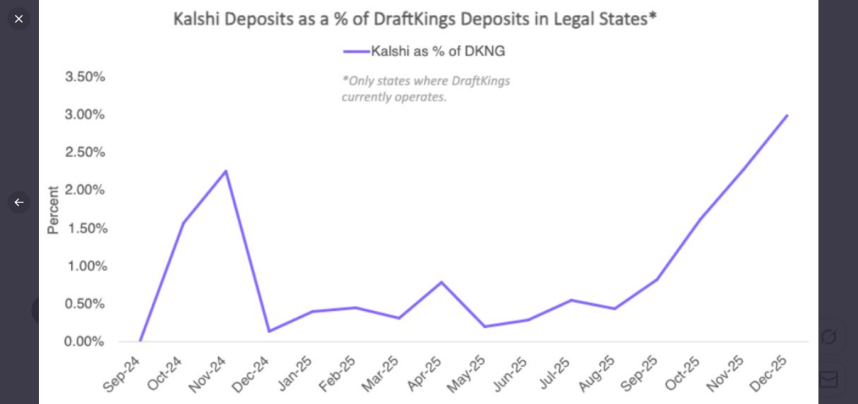
“In states where both DraftKings and Kalshi operate, Kalshi’s deposits relative to DraftKings are significantly lower, representing only 3%,” notes Grous.
Forecast Markets May Keep Expanding
Prediction markets have been shown to have lower prices than typical sportsbook providers, despite indications of progress during the Super Bowl. Nonetheless, Grous thinks the business will keep expanding by meeting unmet demand, aided by the rise in sports volume. Additionally, he believes that the market for event contracts is growing outside of sports.
“The real opportunity for prediction markets lies beyond sports,” he wrote. “The larger prize is in markets where the addressable opportunity is significantly greater, and competition is less direct.”
Through its many exchange-traded funds (ETFs), Cathie Wood's ARK owns shares of DraftKings and Robinhood (NASDAQ: HOOD), one of the largest prediction market companies. The company recently made an investment in privately held Kalshi.